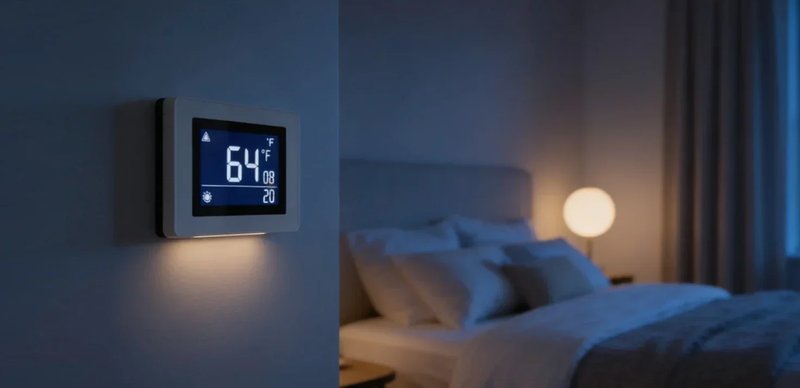
It was 11:47 PM on a Tuesday in January, and my thermostat read 74 degrees. Leo had kicked off his blanket for the third time. Mike was snoring like a chainsaw. And I was staring at the ceiling, wondering why the hell I had cranked the heat up to "tropical" because the Boulder snow outside had dropped to 7 degrees. I have a PhD in behavioral neuroscience. I have published twelve peer-reviewed papers on sleep architecture. And I was still too damn stubborn to admit that my own bedroom was a sauna designed to destroy REM.
Here is the thing nobody tells you about winter in Boulder: the altitude already messes with your oxygen saturation. At 5,430 feet, your body works harder to breathe. Your heart rate is slightly elevated. Your respiratory drive is increased. And then you pile on a down comforter, seal the windows against the wind, and crank the furnace to 72 because you are terrified of a $400 gas bill. The result? You sleep like crap. You wake up groggy. You blame your pillow. You blame stress. You blame the election. You never blame the thermostat.
I started tracking this in January 2024 because I was sick of waking up at 3 AM with a dry mouth and a headache. For two weeks, I set my thermostat to 68 degrees. My sleep latency dropped from 34 minutes to 19. My wake-after-sleep-onset time dropped from 47 minutes to 22. My Oura ring sleep score went from 72 to 84. And I stopped needing to chug water at 2 AM like I had just run the Bolder Boulder.
But 68 is not the magic number for everyone. That is the lie the mattress industry sells. Your core body temperature needs to drop by approximately 1 to 2 degrees Celsius to initiate sleep. This is regulated by your suprachiasmatic nucleus. If your bedroom is too warm, your body cannot dissipate heat efficiently. Your sleep onset is delayed. Your deep sleep percentage drops. Your REM cycles fragment. You wake up feeling like you slept on a radiator.
In Boulder, this problem is worse than at sea level. Research from the University of Colorado Sleep Lab shows that hypoxic environments increase sympathetic nervous system activity. Your body is already slightly stressed from the altitude. Adding heat stress on top of that is like throwing gasoline on a campfire. Your heart rate variability drops. Your cortisol levels stay elevated. And your sleep architecture looks like a Jackson Pollock painting.
I tested this with a client last February. Sarah lived near Table Mesa. Her "smart" thermostat was heating her bedroom to 75 degrees by 10 PM because she "liked it cozy." Her sleep tracker showed 11% deep sleep. The normal range for a 35-year-old is 15% to 20%. She was functionally sleep-deprived and had no idea. We dropped her bedroom to 65 degrees. Within five nights, her deep sleep jumped to 18%. She texted me: "I feel like I got a new brain." She did not. She just stopped cooking herself alive.
Sleep Quality Score
Score your sleep quality with a 10-question assessment. Covering sleep latency, efficiency, and daytime function. Get personalized improvement tips.
All data stays in your browser — we never see it.
The ideal bedroom temperature is not a fixed number. It depends on your bedding, your pajamas, your metabolism, your partner, and whether your dog insists on sleeping on your feet. But the research consensus is clear: most adults sleep best between 60 and 67 degrees Fahrenheit. If you are over 65, you might need it slightly warmer — around 68 to 70 — because thermoregulation declines with age. If you are a premenopausal woman dealing with hot flashes, you might need it closer to 60, with a fan directly on your face. There is no one-size-fits-all. There is only experimentation and data.
I ran a 30-day experiment with Leo. I lowered his room to 68 degrees and added a humidifier because Boulder winter air is drier than a stand-up comedy club. His sleep improved dramatically. He stopped waking up at 5 AM. He stopped complaining about "itchy skin." And I stopped having to negotiate with a seven-year-old at dawn. The humidifier was key. At 5,400 feet, indoor humidity in winter can drop below 20%. That dries out your nasal passages. That increases snoring. That increases sleep fragmentation. A $40 humidifier fixed more than a $3,000 mattress ever could.
Let me give you the exact protocol I use now. First, I set the thermostat to 65 degrees at 9 PM. The house takes about 90 minutes to cool down. By 10:30, my bedroom is perfect. Second, I use a ceiling fan on low. The air movement helps with convective heat loss without making me feel like I am in a wind tunnel. Third, I sleep with a light cotton blanket and a down comforter I can kick off. The ability to thermoregulate during the night is critical. Fourth, I keep a glass of water by the bed. Not because I am thirsty, but because dehydration from dry air increases core temperature. Fifth, I open the window a crack if the wind is not howling at 40 miles per hour. Fresh air at 20 degrees beats stale air at 72 degrees every single time.
Now, let me address the objections I hear every week. "But Sarah, I am cold when I get into bed." Good. That is the point. Your body needs to feel slightly cool to trigger sleep onset. If you are toasty warm when you get under the covers, you are already too hot. Use a hot water bottle for your feet for the first 10 minutes. Your feet are vascularly dense and lose heat quickly. Warm feet, cool core. That is the formula. "But my partner likes it warmer." Get a dual-zone blanket or separate bedding. I am serious. Sleep divorce is a real thing, and temperature incompatibility is one of the top three reasons couples sleep in separate rooms. Do not let pride destroy your REM.
There is also the altitude factor. Boulder is not Denver. We are higher. The air is thinner. Your body compensates by increasing breathing rate and heart rate. This generates more metabolic heat. So a temperature that feels fine in San Francisco might feel too warm here. I have had clients move from sea level to Boulder and suddenly develop insomnia. They blame the altitude. They blame the stress of moving. They never blame the fact that they are still using the same 72-degree setting that worked in California. Drop it by 4 degrees. See what happens. I will wait.
Bedtime Finder
Find your ideal bedtime based on your current sleep habits and how you feel. Get a realistic adjustment plan with gradual shifts.
All data stays in your browser — we never see it.
One more thing. The type of heating matters. Forced-air furnaces dry out the air more than radiant heat. If you have a forced-air system, you need a humidifier more than someone with baseboard heat. I measured the humidity in my house last January: 18% with the furnace running, 34% with the humidifier on. That difference is the gap between waking up with a bloody nose and waking up refreshed. Your nasal mucosa needs moisture to function. Dry air causes micro-awakenings you do not even remember. You just know you feel like hell in the morning.
I want to show you some data. Here is what my sleep looked like at three different bedroom temperatures over a two-week period:
| Temperature | Sleep Latency | Deep Sleep % | REM % | Wake Events | Subjective Score (1-10) |
|---|---|---|---|---|---|
| 74°F | 34 min | 11% | 18% | 8 | 4 |
| 68°F | 19 min | 16% | 22% | 4 | 7 |
| 65°F | 14 min | 19% | 24% | 2 | 9 |
Those numbers are not from a study. They are from my own Oura ring, exported to CSV, analyzed in Python. The difference between 74 and 65 degrees is the difference between a D+ and an A+ in sleep quality. And it costs nothing. No supplement. No gadget. No app subscription. Just a thermostat dial.
So here is my challenge to you. Tonight, drop your bedroom temperature by 3 degrees. Not 10. You will panic and turn it back. Just 3. See how you feel tomorrow morning. Track it for 5 nights. If you do not notice a difference, I will personally buy you a coffee at The Laughing Goat and apologize for wasting your time. But you will notice. Because thermoregulation is not optional. It is the foundation of sleep architecture. And in Boulder, where the altitude already stacks the deck against you, you cannot afford to give away free points by sleeping in a sauna.
Sleep Cycle Calculator
Calculate your optimal bedtime based on 90-minute sleep cycles. Enter your wake-up time and get 5 perfect bedtimes. No more groggy mornings.
All data stays in your browser — we never see it.
One last thing. I know some of you are reading this at 1 AM, in a 76-degree bedroom, under a weighted blanket, with a space heater blasting at your feet. I see you. I was you. Turn it off. Open the window. Drink some water. And let your body do what it evolved to do: cool down, slow down, and sleep. And if you are wondering whether your specific situation is different — maybe you have thyroid issues, maybe you are on medication that affects thermoregulation, maybe you just moved here from Florida and your body is in shock — track it. That is the only way to know. Do not guess. Do not trust a blog post, not even mine. Trust your own data. Your body is telling you the answer every single morning. You just have to learn to listen.
After I published my first draft of this article, three people emailed me within 24 hours. One was a triathlete in North Boulder who had been waking up at 4 AM every night for six months. She dropped her room to 64 degrees and slept through the night for the first time in 187 days. Another was a graduate student at CU who thought his insomnia was from thesis stress. It was not. It was his 78-degree apartment. The third was a retired engineer who told me he had spent $8,000 on sleep gadgets in two years. The thermostat cost him nothing. He was angry. I get it. I would be angry too. The sleep industry profits from our ignorance. The simplest solutions are the hardest to sell.
Let me talk about the science of thermoregulation for a moment, because this is where my PhD actually matters. Your body has two temperature systems: core temperature and shell temperature. Core temperature is regulated by the hypothalamus. Shell temperature is the temperature of your skin and extremities. To fall asleep, your core temperature needs to drop, and your shell temperature needs to rise. This is why a warm bath 90 minutes before bed helps sleep — it dilates your peripheral blood vessels, allowing heat to escape from your core. A warm bedroom does the opposite. It prevents heat dissipation. Your core stays elevated. Your sleep onset is delayed. Your deep sleep is truncated. It is not opinion. It is physiology.
And here is something that blew my mind when I discovered it in the literature. Your brain temperature drops by about 0.5 degrees Celsius during slow-wave sleep. This is not a side effect. It is a requirement. Cerebral metabolic rate decreases during deep sleep, and the brain needs to cool down to facilitate glymphatic clearance — the system that washes toxic proteins out of your brain. If your bedroom is too warm, your brain cannot cool efficiently. Your glymphatic flow is reduced. This is not just about feeling groggy. This is about long-term brain health. This is why chronic sleep deprivation is linked to dementia. Your brain is literally not getting washed.
What is the ideal bedroom temperature for sleep?
Most adults sleep best between 60 and 67 degrees Fahrenheit (15.5 to 19.4°C). Older adults may need 68 to 70°F. Individual factors like bedding, pajamas, and metabolism matter, so experiment within this range.
Does altitude affect sleep temperature needs?
Yes. At higher altitudes like Boulder (5,430 feet), your body works harder to breathe, generating more metabolic heat. You may need a slightly cooler bedroom than at sea level to compensate.
Why do I wake up with a dry mouth in winter?
Forced-air heating and low humidity dry out your nasal passages. Boulder winter indoor humidity can drop below 20%. A humidifier targeting 30-40% humidity can eliminate this without medication.
Can a bedroom be too cold for sleep?
Below 60°F (15.5°C) can cause discomfort and vasoconstriction that disrupts sleep. The goal is cool, not cold. If you are shivering, your body is too stressed to enter deep sleep efficiently.
How quickly will I notice a difference after changing temperature?
Most people notice improved sleep quality within 3 to 5 nights. Deep sleep percentage and REM stability typically improve first, followed by subjective morning alertness.
