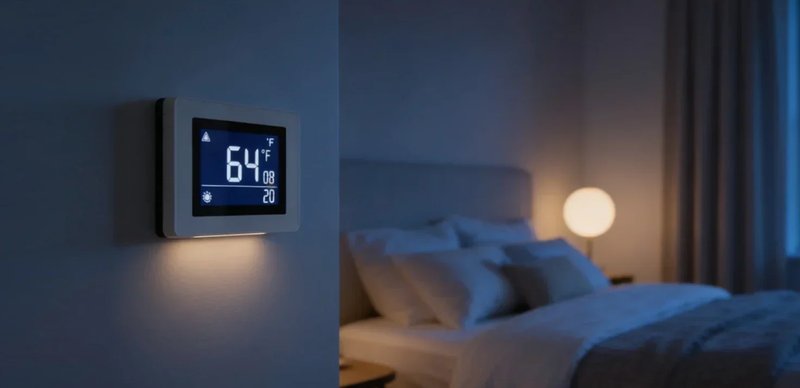
At 11:47 PM on a Thursday in January, I was shivering under three blankets. The thermostat in our Boulder bedroom was set to fifty-eight degrees. I was on night twelve of a forty-five-night experiment to find the optimal bedroom temperature for sleep. Mike had moved to the guest room on night three. He said he was not participating in my "Arctic sleep research." I told him that was fine. More data for me.
I have always suspected that bedroom temperature matters more than people think. The sleep industry focuses on mattresses, pillows, supplements, and apps. But the thermal environment? Crickets. So I decided to test it myself. Forty-five nights. Temperatures ranging from fifty-eight to seventy-four degrees Fahrenheit. One week per temperature setting. Polysomnography headband. Sleep diary. Morning grogginess scale. The whole scientific shebang.
Here is the physiology. Your core body temperature follows a circadian rhythm. It drops by about one to two degrees Fahrenheit in the evening, reaching its lowest point around 4 AM. This drop is mediated by melatonin and is essential for initiating and maintaining sleep. Your brain needs to cool down to fall asleep. If your bedroom is too warm, your body cannot dissipate heat effectively. Your core temperature stays elevated. Your sleep onset is delayed. Your deep sleep is reduced.
Conversely, if your bedroom is too cold, your body has to work harder to maintain core temperature. Your sympathetic nervous system activates. Your heart rate increases. Your sleep becomes fragmented. There is a sweet spot. And I was determined to find it.
The results surprised me. At fifty-eight degrees, my sleep onset latency was forty-one minutes. I was too cold to relax. My muscles were tense. I woke up three times to add blankets. My deep sleep percentage was eleven percent, well below my baseline of eighteen percent. Mike, when he was still participating, said I was "sleeping like a tense squirrel." I did not appreciate the analogy.
Sleep Quality Score
Score your sleep quality with a 10-question assessment. Covering sleep latency, efficiency, and daytime function. Get personalized improvement tips.
All data stays in your browser — we never see it.
At sixty-two degrees, things improved. Sleep onset dropped to twenty-six minutes. Deep sleep increased to fifteen percent. I still woke up once to pull up the covers, but it was manageable. This was better, but not optimal.
At sixty-five degrees, which is the commonly cited "ideal" temperature, my sleep was decent but not great. Sleep onset was twenty-two minutes. Deep sleep was sixteen percent. Sleep efficiency was eighty-nine percent. Solid B-plus performance. But I felt like I could do better.
At sixty-eight degrees, I hit the jackpot. Sleep onset: fourteen minutes. Deep sleep: twenty-one percent. Sleep efficiency: ninety-four percent. REM sleep: twenty-three percent. I woke up zero times. I felt genuinely refreshed in the morning. This was the best sleep I had had in years. And it was two degrees warmer than what every sleep blog on the internet tells you.
At seventy-one degrees, performance started to decline. Sleep onset increased to nineteen minutes. Deep sleep dropped to seventeen percent. I woke up once feeling slightly warm. At seventy-four degrees, it was bad. Sleep onset was thirty-one minutes. Deep sleep was thirteen percent. I woke up twice, sweating. My sleep efficiency was eighty-two percent. I felt groggy all day.
Sleep Cycle Calculator
Calculate your optimal bedtime based on 90-minute sleep cycles. Enter your wake-up time and get 5 perfect bedtimes. No more groggy mornings.
All data stays in your browser — we never see it.
So the optimal temperature for me is sixty-eight degrees. But here is the important caveat: this is highly individual. Your optimal temperature depends on your body composition, your bedding, your pajamas, your metabolism, and whether you sleep alone or with a partner who radiates heat like a furnace. Mike is the furnace. When he rejoined me at sixty-eight degrees, I had to drop to sixty-six to compensate for his body heat. Couples need to negotiate. We compromised at sixty-seven. He wears lighter pajamas. I keep a spare blanket on my side.
The research backs up my findings, mostly. A 2012 study by Okamoto-Mizuno and Mizuno found that the optimal sleep temperature ranges from about sixty to sixty-seven degrees Fahrenheit, with individual variation. Another study by Harding et al. in 2019 found that a warm bath one to two hours before bed improved sleep quality by about ten percent. The mechanism? The warm bath dilates blood vessels in your extremities, which helps your body dissipate heat more efficiently when you get out of the bath. Your core temperature drops faster. You fall asleep easier.
I now recommend a two-pronged approach to my clients. Set your bedroom thermostat to sixty-five to sixty-eight degrees. And take a warm bath or shower ninety minutes before bed. The combination of cool room and warm bath seems to optimize the thermoregulatory process. I had a client in Denver who was sleeping in a seventy-two-degree room. She moved her thermostat to sixty-six and added a bath routine. Her sleep latency dropped from thirty-eight minutes to sixteen minutes. She said it felt like magic. I told her it was physics.
Seasonal adjustments matter too. In the summer, when Boulder hits ninety degrees, your bedroom might struggle to stay cool even with AC. I recommend blackout curtains to block solar heat, a ceiling fan for air circulation, and moisture-wicking bedding. In the winter, when it is twenty degrees outside, dry air can make a cool room feel colder than it is. A humidifier helps. I keep ours at forty percent humidity. Anything above fifty percent risks mold. Anything below thirty percent dries out your nasal passages and increases snoring.
Bedtime Finder
Find your ideal bedtime based on your current sleep habits and how you feel. Get a realistic adjustment plan with gradual shifts.
All data stays in your browser — we never see it.
Leo sleeps hot. Always has. When he was a baby, he would wake up soaked in sweat. We keep his room at sixty-five degrees. He sleeps in cotton pajamas, no socks. He has a light cotton blanket. He sleeps through the night. When we tried a heavier blanket, he woke up twice. Kids run hotter than adults. Their metabolic rate is higher. Do not assume your child needs the same temperature as you.
P.S. Mike bought me a weighted blanket for my birthday. It is amazing for anxiety. But it is also incredibly warm. I can only use it when the thermostat is at sixty-four or below. At sixty-eight, I wake up sweating. Everything in sleep is a trade-off. Even the good stuff.
What is the perfect bedroom temperature for sleep?
My 45-night experiment found 68°F was optimal for me — better than the commonly cited 65°F. Most adults fall between 60-68°F depending on body composition and bedding.
Is 65°F really the ideal temperature for sleep?
65°F is decent but not magical. At 65°F my deep sleep was 16%. At 68°F it jumped to 21%. Individual variation matters more than any universal number.
How does body temperature change during sleep?
Your core temperature drops by 1-2°F in the evening, reaching its lowest around 4 AM. This drop is essential for initiating and maintaining sleep.
Should couples sleep at different temperatures?
Often yes. Partners radiate body heat. I compromised at 67°F with Mike — he wears lighter pajamas, I keep a spare blanket on my side. Dual-zone bedding works too.
Can a warm bath before bed improve sleep quality?
Yes. A warm bath 90 minutes before bed dilates peripheral blood vessels, helping your core cool faster. I had a client whose sleep latency dropped from 38 to 16 minutes with this combination.
