It was 2:47 PM on a Wednesday, and I was drinking my third cup of coffee. Not because I was tired. Because I was bored. Because I was procrastinating on writing a grant proposal. Because the coffee shop on Pearl Street had a comfortable chair and I did not want to go back to my office. I finished the cup, went home, and could not fall asleep until 1:30 AM. I have a PhD in sleep science. I know exactly how caffeine works. And I still screwed up. If I can mess this up, anyone can. And almost everyone does.
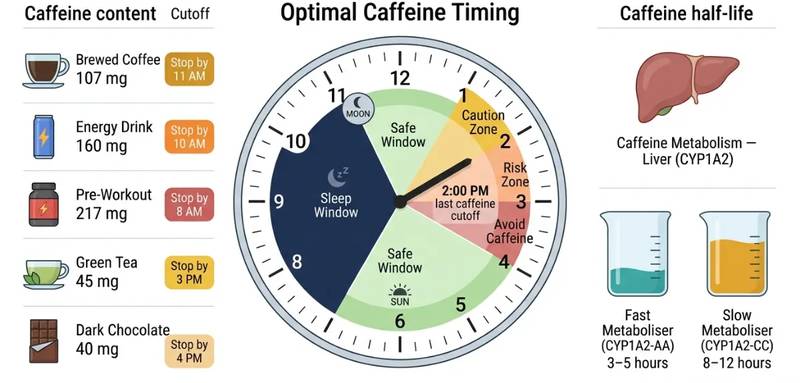
Caffeine is the most widely used psychoactive drug in the world. Eighty-five percent of Americans consume it daily. The average intake is 200 mg — about two cups of coffee. But the range is enormous. Some people drink 600 mg and sleep fine. Others have a single espresso at 10 AM and stare at the ceiling at midnight. The difference is not willpower. It is genetics. Specifically, a gene called CYP1A2, which codes for the enzyme that metabolizes caffeine in your liver. If you have the fast metabolizer variant, you clear caffeine in 3 to 4 hours. If you have the slow variant, it can take 8 to 10 hours. And you cannot know which variant you have without a genetic test. So most people are guessing. And guessing wrong.
Here is the basic pharmacology. Caffeine is an adenosine receptor antagonist. Adenosine is the neurotransmitter that builds up in your brain throughout the day and makes you feel sleepy. It is sleep pressure in molecular form. Caffeine blocks the receptors that adenosine binds to. So you do not feel sleepy. But adenosine is still building up. It is still there, waiting. When the caffeine finally wears off, all that accumulated adenosine hits at once. This is the 3 PM crash. This is why you need another cup. And another. And suddenly it is 8 PM and you have 400 mg of caffeine in your system and your brain is screaming for sleep but the chemistry will not allow it.
The half-life of caffeine is about 5 to 6 hours for the average person. But "average" is a dangerous word in biology. For slow metabolizers, the half-life can be 10 hours. That means if you have a cup of coffee at 2 PM, half of it is still in your system at midnight. A quarter is still there at 6 AM. You are essentially sleeping with caffeine in your brain. And caffeine does not just keep you awake. It fragments your sleep. It reduces deep sleep by an average of 19%. It reduces REM sleep by 13%. It increases wake-after-sleep-onset time. You might fall asleep eventually, but your sleep quality is destroyed. And you do not even know it, because you are unconscious.
I tested this on myself in February 2025. For two weeks, I had my last caffeine at 10 AM. For the next two weeks, I had it at 2 PM. For the final two weeks, I had it at 6 PM. I tracked everything: sleep latency, deep sleep percentage, REM percentage, wake events, subjective morning score. The results were damning. At 10 AM cutoff, my sleep latency was 14 minutes, deep sleep was 19%, REM was 23%. At 2 PM cutoff, sleep latency was 28 minutes, deep sleep was 14%, REM was 19%. At 6 PM cutoff, sleep latency was 47 minutes, deep sleep was 9%, REM was 15%. I was functionally sleep-deprived by the end of the 6 PM week. And I felt it. I was irritable. I was forgetful. I snapped at Leo over a spilled glass of milk. That is not who I want to be.
Sleep Cycle Calculator
Calculate your optimal bedtime based on 90-minute sleep cycles. Enter your wake-up time and get 5 perfect bedtimes. No more groggy mornings.
All data stays in your browser — we never see it.
But here is the complication. Caffeine is not just in coffee. It is in tea. It is in chocolate. It is in energy drinks. It is in pre-workout supplements. It is in some medications. A single dark chocolate bar can have 70 mg of caffeine. A cup of green tea has 35 mg. A can of Coke has 34 mg. These add up. I had a client who swore she had no caffeine after noon. But she was eating dark chocolate at 9 PM while watching Netflix. She was consuming 80 mg of caffeine right before bed and had no idea. We switched her to milk chocolate — 10 mg — and her sleep improved by 22% in one week. The devil is in the details.
So what is the right cutoff? The research consensus is 6 to 8 hours before bedtime. But that is for average metabolizers. If you are a slow metabolizer, you need 10 to 12 hours. If you are a fast metabolizer, you might get away with 4 to 5 hours. The only way to know is to experiment. Track your sleep for a week with a 2 PM cutoff. Then a week with a 10 AM cutoff. Then a week with a 6 PM cutoff if you are brave. See what happens. Your data will tell you the answer. Not me. Not a blog post. Your own body.
I have developed a simple calculator for my clients. It is not fancy. It does not require a genetic test. It just requires honesty. Step 1: What time do you want to fall asleep? Step 2: What is your typical caffeine intake per day? Step 3: How sensitive do you think you are? Step 4: The calculator gives you a cutoff time based on a conservative estimate. If you are sensitive, it adds 2 hours. If you are a heavy user, it adds 1 hour because tolerance does not eliminate the sleep-fragmenting effects — it just masks the feeling of alertness. This is a critical distinction. Tolerance means you do not feel wired. It does not mean caffeine is not destroying your sleep architecture.
Let me give you some real numbers. A standard 8-oz cup of brewed coffee has 95 mg of caffeine. A Starbucks grande has 310 mg. A 5-Hour Energy has 200 mg. A cup of black tea has 47 mg. A cup of green tea has 35 mg. A can of Red Bull has 80 mg. A square of dark chocolate (70% cacao) has 25 mg. Add these up. If you have a grande Starbucks at 9 AM, a green tea at 1 PM, and two squares of dark chocolate at 8 PM, your total caffeine exposure is 310 + 35 + 50 = 395 mg. And you are still metabolizing it at midnight. No wonder you cannot sleep.
Nap Planner
Calculate the perfect nap length and timing. Avoid sleep inertia with our 10-minute vs 90-minute nap guide. Plan your power nap like a pro.
All data stays in your browser — we never see it.
There is also the issue of caffeine timing and your circadian rhythm. Caffeine has a phase-delaying effect on your circadian clock. It pushes your melatonin onset later. A 2015 study from the University of Colorado Boulder — my old lab — found that a double espresso consumed 3 hours before bed delayed melatonin onset by 40 minutes. That is almost a full sleep cycle. So even if you fall asleep eventually, your entire circadian phase is shifted. You are living in the wrong time zone, chemically. And the only way to fix it is to stop the caffeine earlier.
Decaf is not the answer either. Decaf coffee still has 5 to 15 mg of caffeine per cup. If you are extremely sensitive, that matters. Herbal tea is the only truly caffeine-free option. Chamomile, peppermint, rooibos — these are safe. But read the labels. Some "herbal" teas contain yerba mate or guayusa, which have caffeine. The supplement industry is not your friend. They will put caffeine in anything and call it "natural energy." Natural or not, it is still a drug that blocks your adenosine receptors.
My personal cutoff is 12 PM. I am a slow metabolizer — I had genetic testing done in 2023 because I was curious. If I have caffeine after noon, my sleep is compromised. Period. So I have my coffee in the morning, switch to herbal tea after lunch, and avoid chocolate after 6 PM. Is it restrictive? Yes. Do I miss the afternoon espresso? Sometimes. But I sleep better than I have in years. And my morning energy is real, not borrowed from a chemical loan shark that collects interest at midnight.
Here is my challenge to you. For one week, stop all caffeine 8 hours before your target bedtime. Track your sleep. Use a tracker, a journal, whatever. Just track it. I guarantee you will see improvement. And if you do not, you might be one of the lucky fast metabolizers who can drink espresso at 8 PM and sleep like a baby. In which case, I am jealous. But most of you are not. Most of you are slowly poisoning your sleep with a drug you do not even think of as a drug. It is time to wake up. Metaphorically, of course. Because once you fix this, you will wake up literally too. And feel better than you have in years.
Bedtime Finder
Find your ideal bedtime based on your current sleep habits and how you feel. Get a realistic adjustment plan with gradual shifts.
All data stays in your browser — we never see it.
One last thing. I have a client who is a software developer at a startup in Boulder. He was drinking 4 cups of coffee a day, plus a pre-workout supplement at 5 PM before his evening climb at Movement. His pre-workout had 300 mg of caffeine. He was consuming 680 mg of caffeine daily, with the last dose at 5 PM. He could not fall asleep before 2 AM. He was waking up at 7 AM for work. He was getting 5 hours of sleep. And he thought he was "just a night owl." He was not. He was caffeine-poisoned. We cut his pre-workout. We moved his last coffee to 10 AM. Within 10 days, he was falling asleep at 11 PM. He told me he felt like he had "discovered a cheat code for life." He had not. He had just stopped sabotaging himself. And that is the real secret. Most sleep problems are self-inflicted. And most self-inflicted problems are fixable. You just have to know what you are doing to yourself.
| Caffeine Source | Caffeine (mg) | Half-Life Clearance | Sleep Impact |
|---|---|---|---|
| Starbucks Grande Coffee | 310 | 15-20 hrs (slow) / 6-8 hrs (fast) | Severe |
| Home Brewed Coffee (8oz) | 95 | 5-10 hrs | Moderate |
| Black Tea (8oz) | 47 | 3-6 hrs | Mild |
| Dark Chocolate (1oz) | 25 | 2-5 hrs | Low-Moderate |
| Green Tea (8oz) | 35 | 3-6 hrs | Mild |
What is the best time to stop drinking caffeine for sleep?
For most people, 6 to 8 hours before bedtime. Slow metabolizers may need 10 to 12 hours. Fast metabolizers might tolerate 4 to 5 hours. The only way to know your personal cutoff is to experiment and track your sleep data.
Does decaf coffee affect sleep?
Decaf still contains 5 to 15 mg of caffeine per cup. For highly sensitive individuals, this can still fragment sleep. Herbal teas like chamomile and rooibos are truly caffeine-free alternatives.
Can I build a tolerance to caffeine so it does not affect my sleep?
Tolerance masks the feeling of alertness but does not eliminate caffeine's sleep-fragmenting effects. You may not feel wired, but your deep sleep and REM are still being reduced. Tolerance is not protection.
How much caffeine is in common foods and drinks?
A Starbucks grande has 310 mg. Home-brewed coffee has 95 mg per 8 oz. Black tea has 47 mg. Green tea has 35 mg. Dark chocolate has 25 mg per ounce. These add up quickly and can push total daily intake over 400 mg.
Does caffeine affect my circadian rhythm?
Yes. A 2015 University of Colorado Boulder study found that a double espresso 3 hours before bed delayed melatonin onset by 40 minutes. Caffeine phase-delays your circadian clock, shifting your entire sleep-wake cycle later.
