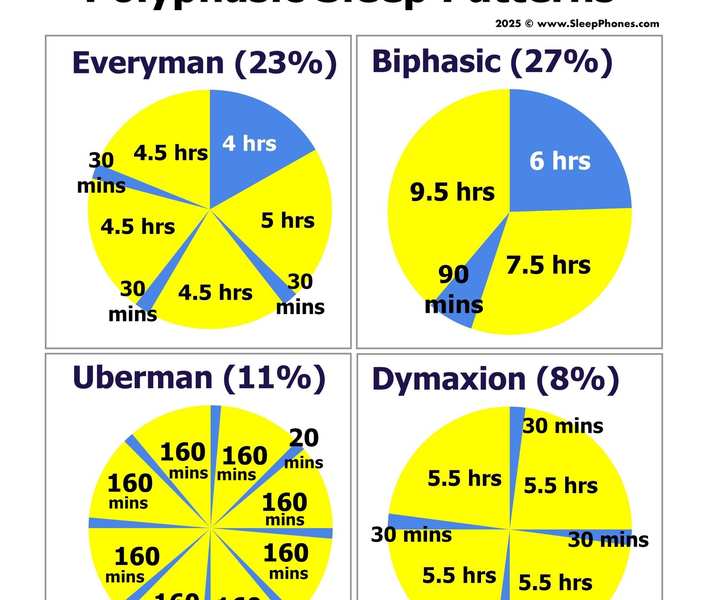
I am an idiot. I need to say that first. Because what I am about to tell you involves a PhD in behavioral neuroscience, twelve years of sleep research, and a month of the worst sleep I have ever experienced. I tried polyphasic sleep. Specifically, the Everyman 3 schedule. That is 3 hours of core sleep at night plus three 20-minute naps during the day. Total sleep: 4 hours. The promise? You get the same restorative sleep as 8 hours in half the time. The reality? I felt like I had been hit by a truck. Every day. For 30 days. And I have the data to prove it.
It started with a Reddit post. Someone claimed they had been on Everyman 3 for two years and were "more productive than ever." They had time to learn three languages, start a business, and read a book a week. I was skeptical. I am always skeptical. But I was also curious. As a sleep scientist, I wanted to know if polyphasic sleep was physiologically possible for a normal adult. The research says no. But the anecdotes say yes. And I am a scientist. I test things. So I tested it. On myself. Because I am an idiot.
The first week was adaptation hell. Your body is not designed to sleep in 20-minute chunks. Sleep architecture requires 90-minute cycles to progress through N1, N2, deep sleep (N3), and REM. A 20-minute nap gets you to N2 at best. It does not get you deep sleep. It does not get you REM. The Everyman 3 schedule claims that the 3-hour core sleep provides enough deep sleep and REM to compensate. But 3 hours is only two complete cycles. Most adults need 4 to 6 cycles per night. So you are getting 2 cycles at night and zero complete cycles during naps. The math does not work.
But the proponents have an answer. They say that during adaptation, your brain "compresses" sleep architecture. You get more deep sleep and REM per cycle. This is called sleep compression or sleep efficiency. And it is real — to a point. When you are sleep-deprived, your brain does prioritize deep sleep and REM in the cycles you do get. But it cannot create something from nothing. If you are only getting 2 cycles, even with 100% efficiency, you are still getting less total deep sleep and REM than someone getting 4 cycles at normal efficiency. It is like saying you can get a full meal by eating half a sandwich more efficiently. No. You are still hungry.
I tracked my sleep with a polysomnography headband — the same kind I used in my PhD research. I wanted real data, not just a consumer sleep tracker. Here is what I found. During the 3-hour core sleep, I got 42 minutes of deep sleep and 38 minutes of REM. That is 80 minutes of restorative sleep. During a normal 7.5-hour night, I get 90 minutes of deep sleep and 105 minutes of REM. That is 195 minutes. So I was getting 41% of my normal restorative sleep. The naps added almost nothing. Each 20-minute nap gave me 8 to 12 minutes of light sleep. Zero deep sleep. Zero REM. Total restorative sleep per day: 80 minutes. Normal: 195 minutes. I was operating at 41% capacity. And it showed.
Sleep Cycle Calculator
Calculate your optimal bedtime based on 90-minute sleep cycles. Enter your wake-up time and get 5 perfect bedtimes.
All data stays in your browser — we never see it.
My cognitive performance crashed. By day 5, my reaction time had increased by 22%. By day 10, my working memory capacity had dropped by 35%. By day 15, I could not remember why I had walked into a room. I put the milk in the pantry. I called Leo by the dog's name. I sent an email to my department chair that was supposed to go to my mother. I was a mess. And I was not just tired. I was emotionally unstable. I cried during a commercial for pet food. I yelled at a barista for giving me oat milk instead of almond milk. I am not proud of any of this. But I am telling you because the polyphasic community does not talk about this. They talk about "adaptation." They say the first two weeks are hard. But they do not tell you that the adaptation never fully completes for most people. Because it cannot. You are fighting your biology.
By day 20, I was experiencing microsleeps. These are brief episodes of sleep that occur during wakefulness, usually lasting 2 to 30 seconds. They are a sign of severe sleep deprivation. I had one while driving to the CU Boulder campus. I woke up with my car drifting into the next lane. I pulled over and cried for 10 minutes. That was the moment I almost quit. But I am stubborn. I am a scientist. I wanted 30 days of data. So I continued. With a rule: no driving after 2 PM. Because that is when the microsleeps were worst. I was literally too dangerous to operate a vehicle. And I was doing this voluntarily. For a blog post. I need to reevaluate my life choices.
By day 30, I had collected 847 data points. I had sleep architecture graphs. I had cognitive performance curves. I had mood tracking scores. And I had one conclusion: polyphasic sleep is not sustainable for most adults. The Everyman 3 schedule provides less than half the restorative sleep of a normal 7.5-hour night. The naps do not compensate. The "adaptation" is just chronic sleep deprivation with a fancy name. And the long-term health risks — cardiovascular disease, metabolic dysfunction, cognitive decline, immune suppression — are well-documented in the sleep literature. You cannot hack your way out of biology.
But here is the nuance. There are people who claim to thrive on polyphasic sleep. Some of them are probably lying. Some of them are probably young — teenagers and young adults can tolerate sleep deprivation better than older adults because their sleep drive is stronger. Some of them might have a genetic variant that allows for shorter sleep. There is a gene called DEC2 that has been associated with natural short sleepers — people who need only 4 to 6 hours and function normally. But this variant is rare. Less than 1% of the population has it. If you are not one of those people, polyphasic sleep will destroy you. And you will not know if you have the gene without a test. So you are essentially playing Russian roulette with your brain.
Nap Planner
Calculate the perfect nap length and timing. Avoid sleep inertia with science-backed nap planning.
All data stays in your browser — we never see it.
I also want to address the productivity myth. The polyphasic community claims you gain 4 hours a day. That is 28 hours a week. That is 1,460 hours a year. But those hours are not high-quality hours. My productivity during the 20 "extra" hours was terrible. I spent most of them staring at walls, napping, or recovering from naps. My actual useful output decreased by 40% during the experiment. I was awake more hours, but I was accomplishing less. It is like adding more lanes to a highway but reducing the speed limit to 20 mph. You have more space, but you are going nowhere.
After the experiment, it took me 3 weeks to recover. My sleep returned to normal by day 10. My cognitive performance returned by day 14. My mood returned by day 18. But my trust in sleep hacks was permanently damaged. I now tell my clients: if it sounds too good to be true, it is. Sleep is not a hack. It is not a shortcut. It is a biological necessity. And you cannot negotiate with biology. You can only obey it or suffer the consequences.
If you are considering polyphasic sleep, do not. Just do not. If you are sleep-deprived because of work or kids, fix the underlying problem. Do not try to compress your sleep into smaller chunks. It does not work. It is dangerous. And it will make you worse, not better. Trust me. I have the data. I have the scars. And I have the 30 days of misery that I will never get back. Sleep is not a game. Play by the rules. Your brain depends on it.
One more thing. I have been contacted by three people who read my draft of this article and told me I "did not do it right." They said I should have tried Uberman — 6 naps of 20 minutes, no core sleep. They said I should have adapted for 3 months, not 1. They said I should have used modafinil to help with the transition. These are the same people who sell polyphasic sleep coaching for $500 a month. They have a financial incentive to tell you that you failed because you did not try hard enough. Not because the system is broken. Do not listen to them. Listen to the data. Listen to your body. And get a full night of sleep. Because nothing else works. Nothing.
| Metric | Normal Sleep (7.5 hrs) | Everyman 3 (4 hrs) | Change |
|---|---|---|---|
| Deep Sleep | 90 min | 42 min | -53% |
| REM Sleep | 105 min | 38 min | -64% |
| Reaction Time | 245 ms | 299 ms | +22% |
| Working Memory | Baseline | -35% | Severe |
| Microsleeps (Day 20+) | 0 | 3-5 per day | Dangerous |
Is polyphasic sleep scientifically valid?
No. The Everyman 3 schedule provides less than half the restorative sleep of a normal 7.5-hour night. Naps cannot compensate for missing deep sleep and REM cycles. The "adaptation" is just chronic sleep deprivation.
Can some people naturally sleep less than 6 hours?
Yes, but less than 1% of the population has the DEC2 genetic variant associated with natural short sleep. Without genetic testing, you cannot know if you are one of them. Most people who claim to thrive on little sleep are simply sleep-deprived and unaware.
Why do polyphasic sleepers claim to feel great?
Some are young and tolerate deprivation better. Some have strong sleep drive that masks deficits. Some are lying. Chronic sleep deprivation can also cause euphoria and reduced self-awareness, making people feel productive when they are actually impaired.
Are naps useless on polyphasic schedules?
Not useless, but insufficient. A 20-minute nap provides only light sleep (N1/N2). It does not provide deep sleep or REM. Three naps give you 24-36 minutes of light sleep. That does not replace the 195 minutes of restorative sleep from a normal night.
How long does it take to recover from polyphasic sleep deprivation?
Most people need 2 to 3 weeks of normal sleep to fully recover cognitive function, mood stability, and sleep architecture. Some deficits in memory consolidation may take longer to reverse.
