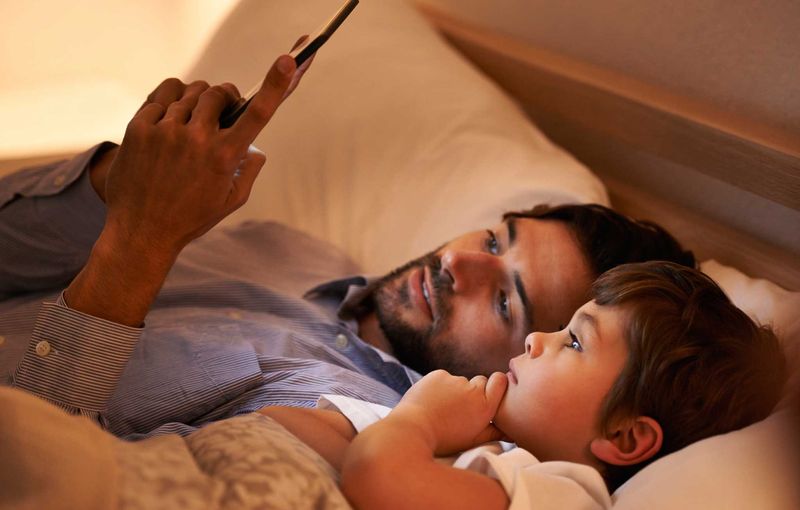
At 8:47 PM on a Tuesday, Leo looked at me with the eyes of a seasoned negotiator. "Just one more episode," he said. "It is only twenty-two minutes. Please. I will go to bed right after. I promise." He had already said this three times. We were now on episode four. His bedtime was 8:30. It was 8:47. And I was losing.
I have a PhD in sleep science. I have published papers on circadian rhythms in children. I know exactly what blue light and stimulating content do to a developing brain. And I still struggle with screen time rules. Because parenting is not a laboratory. It is a war zone. And the enemy is a seven-year-old with an iPad and a bottomless appetite for cartoons.
Here is what the research says. The American Academy of Pediatrics recommends no screens for children under eighteen months, except video chatting. For ages two to five, they recommend one hour per day of high-quality programming. For ages six and older, they recommend consistent limits that do not interfere with sleep, physical activity, or other healthy behaviors. These guidelines are evidence-based and important. They are also completely unrealistic for most modern families.
The problem is not just the amount of screen time. It is the timing. Screens before bed are the real sleep killer. A 2014 study by Carter and colleagues in JAMA Pediatrics found that children who used screens in the hour before bed had significantly later bedtimes, shorter sleep duration, and poorer sleep quality. The effect was dose-dependent. More screen time meant worse sleep. And it was not just about the light. The content mattered too. Action-packed shows activated the sympathetic nervous system. Social media triggered FOMO and social comparison. Even "educational" apps kept the brain engaged when it should be winding down.
Bedtime Finder
Find your ideal bedtime based on your current sleep habits and how you feel. Get a realistic adjustment plan.
All data stays in your browser — we never see it.
I made a rule for Leo. No screens after 7 PM on school nights. None. Not even educational games. Not even video calls with grandma. The screen goes off at 7. Period. The initial week was hell. He begged. He bargained. He cried. He told me I was the meanest mom in Boulder. I held firm. By week two, he stopped asking. By week three, he started reading books before bed instead. By week four, his sleep latency dropped from thirty-four minutes to twelve minutes. He woke up easier. He was less cranky in the morning. His teacher noticed.
But here is the thing. The rule only works because we have alternatives. If you take away screens without replacing them with something else, you create a vacuum. And nature abhors a vacuum. Leo has a bookshelf full of graphic novels. He has LEGO sets. He has drawing supplies. He has a dog who loves evening walks. The hour between 7 PM and 8 PM is now "quiet time." He can read, draw, build, or play with Maple. He just cannot look at a screen.
Weekends are different. I am not a monster. On Friday and Saturday nights, Leo gets an extra hour. Screen time ends at 8 PM instead of 7. He can watch one movie on Saturday afternoon. This gives him something to look forward to. It also teaches him that screens are a privilege, not a right. And it prevents the weekday rules from feeling like a prison sentence.
Sleep Cycle Calculator
Calculate your optimal bedtime based on 90-minute sleep cycles. Enter your wake-up time and get 5 perfect bedtimes.
All data stays in your browser — we never see it.
The type of screen matters too. Passive consumption, like watching TV, is less disruptive than interactive consumption, like playing video games. Games require active engagement, decision-making, and emotional investment. They are more stimulating. Leo is not allowed to play video games after 5 PM, even on weekends. TV shows are allowed until 7 on weekdays, 8 on weekends. This distinction matters.
Co-viewing is another strategy that helps. When parents watch with their children, they can discuss the content, ask questions, and provide context. This transforms passive consumption into an interactive experience. It also allows you to monitor what your child is watching. I co-view with Leo for about half of his screen time. The other half, he watches alone while I make dinner. I am not perfect. But I am present.
Modeling matters. Children learn by watching. If you are scrolling your phone at the dinner table, your child learns that screens are more important than people. If you are on your laptop until midnight, your child learns that sleep is optional. I put my phone in a drawer at 7 PM. Mike does too. We are not always successful. But we try. And Leo notices.
Sleep Quality Score
Score your sleep quality with a 10-question assessment covering latency, efficiency, and daytime function.
All data stays in your browser — we never see it.
The bedroom should be a screen-free zone. No TVs. No tablets. No phones. The bed is for sleep. Leo has a clock in his room. That is it. No electronics. When he wakes up in the morning, he reads or plays quietly until his clock says 7 AM. Then he can come get us. This took months to establish. But it works.
P.S. Last week, Leo told his friend that "screens before bed are bad for your brain." His friend said, "Your mom is weird." Leo replied, "Yeah, but she is usually right." I have never been more proud. Or more insulted. Parenting is complicated.
How does screen time before bed affect children's sleep?
Screens suppress melatonin production and activate the sympathetic nervous system. A 2014 JAMA Pediatrics study found children using screens before bed had significantly later bedtimes, shorter sleep duration, and poorer sleep quality.
What is the best screen time cutoff for kids?
No screens at least 1-2 hours before bedtime. For school-age children, a 7 PM cutoff on weekdays and 8 PM on weekends provides adequate wind-down time for melatonin onset and sleep preparation.
Are educational apps less disruptive than cartoons before bed?
No. Interactive apps are often more stimulating than passive TV because they require active engagement and decision-making. The brain treats all screen content as activating, regardless of educational value.
How can parents model good screen habits for kids?
Put your own phone away at 7 PM. Do not scroll at the dinner table. Do not work on laptops until midnight. Children learn screen behavior by watching their parents, not by listening to rules.
Should bedrooms be completely screen-free for children?
Yes. The bed should be for sleep only. No TVs, tablets, or phones in the bedroom. This creates a strong sleep-environment association and prevents middle-of-the-night screen checking.
