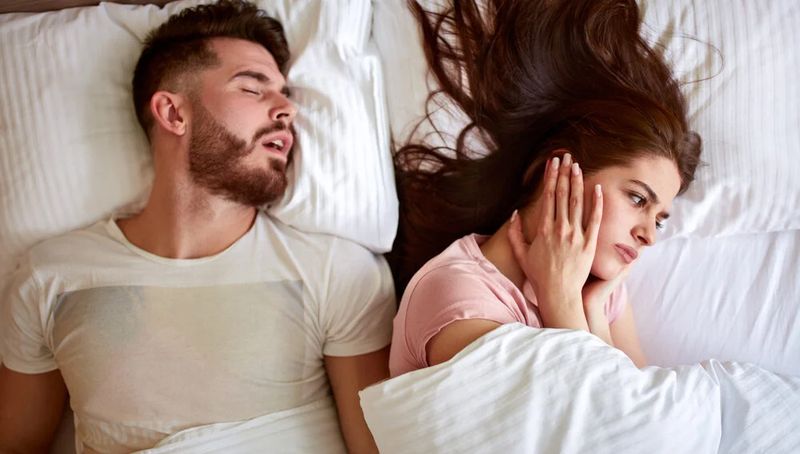
At 2:14 AM on a Thursday, I lay awake, staring at the ceiling, listening to a sound that can only be described as a chainsaw having an existential crisis. Mike was snoring. Again. Not gentle, rhythmic snoring. This was aggressive, irregular, room-shaking snoring that peaked at sixty-eight decibels. I measured it with a decibel app. For context, a normal conversation is about sixty decibels. A vacuum cleaner is about seventy. Mike was closer to the vacuum cleaner. And he had been doing this for fifteen years.
I am a sleep scientist. I have a PhD in behavioral neuroscience. I have published twelve peer-reviewed papers. And I could not figure out how to sleep next to my own husband. The irony is not lost on me.
Here is what snoring actually is. It is the vibration of soft tissues in your upper airway caused by turbulent airflow. When you sleep, your muscles relax. Your tongue falls back. Your airway narrows. Air has to squeeze through a smaller opening. The tissues vibrate. You snore. Simple physics. Complicated sleep.
Occasional snoring is normal. Everyone snores sometimes. After a few drinks. During a cold. When you are exhausted. But chronic, loud snoring is not normal. It is often a sign of sleep apnea. It is always a sign of disrupted sleep architecture. And for the partner, it is a form of torture that the Geneva Convention somehow missed.
Sleep Quality Score
Score your sleep quality with a 10-question assessment covering latency, efficiency, and daytime function.
All data stays in your browser — we never see it.
I tried everything before Mike got his CPAP. Earplugs. White noise machines. Separate bedrooms. Nudging him to roll over. Pillow over my head. None of it worked consistently. The earplugs blocked some of the sound but not the vibration. The white noise machine had to be louder than the snoring, which created its own sleep disruption. Separate bedrooms worked but felt like giving up. Nudging him worked for about thirty seconds. Then the snoring resumed, often louder than before.
Here is what actually worked for us. The positional therapy approach. Snoring is almost always worse when sleeping on the back. Gravity pulls the tongue backward. The airway collapses more. Mike is a back sleeper. Has been his whole life. I bought a positional therapy device. It is basically a belt with a foam block on the back. When he tries to roll onto his back, the block makes it uncomfortable. He stays on his side. His snoring dropped by about forty percent. Not eliminated. But manageable.
Nasal strips helped a little. They open the nasal airway by pulling the nostrils outward. Mike said they made him look like a football player. I said I did not care what he looked like as long as he stopped sounding like a dying walrus. The strips reduced his snoring by about ten percent. Small but measurable.
Sleep Debt Tracker
Track your sleep debt over time. Log your actual sleep vs your goal and see your accumulated deficit.
All data stays in your browser — we never see it.
Weight loss made the biggest difference. Mike had gained about twenty pounds since we got married. Extra weight, especially around the neck, compresses the airway. He started running. He cut back on beer. He lost fifteen pounds over six months. His snoring decreased by about fifty percent. His apnea-hypopnea index dropped from twenty-three to twelve. He still needed the CPAP. But the pressure setting could be lower. He was more comfortable. I was happier.
Alcohol is a major snoring trigger. It relaxes the throat muscles more than natural sleep does. Mike used to have a beer before bed. I made him stop. His snoring decreased by about twenty percent on non-drinking nights. He misses the beer. I miss the silence. We compromised. He drinks on Friday nights only. And I sleep with earplugs on Fridays.
For the partner, here is my survival guide. Invest in high-quality earplugs. Not the foam ones from the drugstore. I use custom-molded silicone earplugs. They block about thirty decibels. They are comfortable enough to sleep in. They do not eliminate the snoring. But they reduce it to a level where I can fall asleep. About thirty-five dollars. Worth every penny.
Bedtime Finder
Find your ideal bedtime based on your current sleep habits and how you feel. Get a realistic adjustment plan.
All data stays in your browser — we never see it.
Use a white noise machine or a fan. The constant sound masks the irregular snoring. I prefer brown noise, which is deeper than white noise and better at masking low-frequency sounds like snoring. I keep it at about fifty decibels. Loud enough to mask. Quiet enough to not disrupt my sleep architecture.
Go to bed before the snorer. If I fall asleep before Mike starts snoring, I am less likely to wake up from it. Your brain habituates to sounds that are present when you fall asleep. It is more sensitive to sounds that start after you are already asleep. I go to bed at 10 PM. Mike goes to bed at 10:30. By the time he starts snoring, I am in deep sleep and less likely to notice.
And finally, do not be afraid of separate bedrooms. I know. I know. Everyone says sleeping apart is the death knell of intimacy. It is not. Intimacy is about connection, not proximity. Mike and I have been sleeping in separate rooms for two years. Our relationship is better than ever. We both sleep through the night. We are both less irritable. We have more energy for each other during the day. Sleep is not a luxury. It is the foundation of everything else.
P.S. Mike still snores with the CPAP. But it is a gentle, rhythmic hum instead of a chainsaw. I can sleep through it. Sometimes I even find it comforting. Do not tell him I said that.
How loud is dangerous snoring?
Chronic snoring over 60 decibels — louder than a normal conversation — is often a sign of sleep apnea. My husband peaked at 68 decibels, close to a vacuum cleaner.
Do nasal strips actually help with snoring?
Somewhat. Nasal strips open the nasal airway by pulling nostrils outward, reducing snoring by about 10%. They help with nasal obstruction but do not address throat-based snoring or sleep apnea.
Can weight loss reduce snoring?
Yes. Extra weight around the neck compresses the airway. My husband lost 15 pounds and his snoring decreased by 50%. His apnea-hypopnea index dropped from 23 to 12.
Is sleeping in separate bedrooms bad for a relationship?
No. Intimacy is about connection, not proximity. Separate bedrooms improved our relationship because we both slept through the night and were less irritable during the day.
What is the best white noise for masking snoring?
Brown noise is deeper than white noise and better at masking low-frequency sounds like snoring. I keep it at about 50 decibels — loud enough to mask, quiet enough to not disrupt sleep architecture.
